Fairy Village
A Werewolf Thing: A Rejected Mate Werewolf RomanceThe faery village is the ancestral settlement of Saphira Richards and Trevor Richards and the central communal space of their faery heritage. Reached after Saphira leaves a car and follows her aunt, it is a place organized by inherited custom, family recognition, leadership succession, and strict boundaries between supernatural peoples. Its significance changes sharply during the narrative: what first appears to be a secluded homecoming becomes the setting for a leadership ritual, a violent Banshee incursion, and the revelation that Saphira and Trevor’s identities carry political obligations.
Setting and Traditions
The village is reached as Saphira and Trevor travel with their family, and its inhabitants live in tents because of tradition. The settlement therefore functions less as an ordinary permanent town than as a communal cultural space whose physical form expresses obedience to inherited practice. Saphira does not understand why the residents live in tents, but accepts that tradition is not to be challenged casually. That detail establishes the village as a society governed by continuity rather than convenience, where belonging depends on entering an already existing order.
The village is also marked by ceremonial domestic spaces. Saphira and Trevor meet their grandfather inside his tent, where he pours them warm tea; the barely visible green leaves in the drink identify it as something their grandmother prepared. The scene joins family intimacy to collective authority. A tent can hold affection, memory, and political instruction at once, making the village’s private spaces inseparable from its clan structure.
Homecoming and Family Recognition
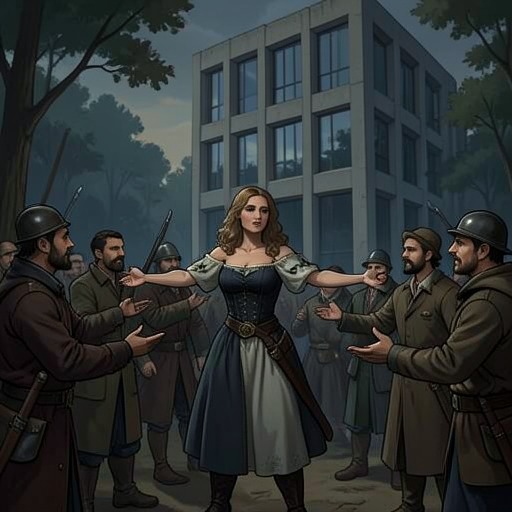
When Saphira enters the village with Trevor beside her, Carmen and Ashton holding her hands, residents rush from their tents as though they already know that the siblings have arrived. Their reception makes the village a place where identity precedes explanation: the community recognizes the returning grandchildren before the narrative describes any formal announcement. An elderly woman forces her way through the crowd, and Saphira identifies her as her grandmother. The grandmother embraces both grandchildren, declaring that they have finally come home, while Saphira and Trevor return the embrace.
This homecoming carries emotional weight because Saphira and Trevor have been separated from the village’s leadership history. Their mother had been the leader of the witches, but after her death her sister—an aunt the family never discusses—assumed that position. The siblings are also half werewolf and half witch. The village therefore receives them not merely as relatives but as heirs whose mixed ancestry complicates the boundaries of the communities around them. Their arrival reconnects family memory with an unresolved succession.
The Faery Ritual and Leadership Claim
The village’s elders quickly disclose that the reunion has a political purpose. Saphira’s grandfather tells her that, as the mate of the future alpha, she is expected to join him as Luna. He then explains that the siblings were summoned to perform the faery ritual. They had been intended to lead the community once they reached eighteen, but their mother’s departure changed that plan. The ritual thus represents an interrupted inheritance being reopened rather than a new opportunity arising without precedent.
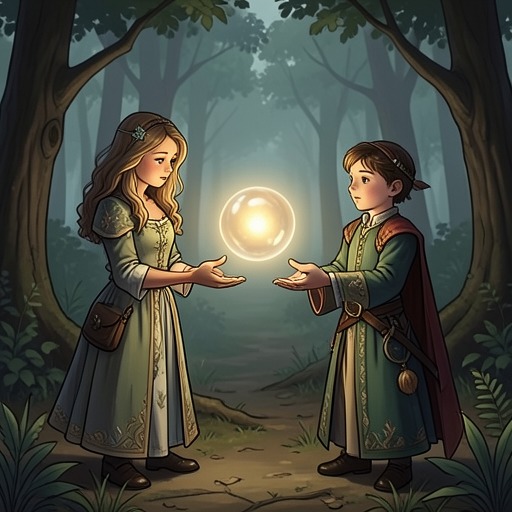
The ceremony takes place before a gathered crowd. A young woman with straight brown hair and light hazel eyes asks for Saphira’s hand and holds it palm-up while bringing a dagger toward it. Ashton stands between Saphira’s grandparents as the rite begins, placing the intimate danger of the ceremony beside the wider network of family and mate relationships. The ritual’s physical action makes succession a matter of blood, bodily vulnerability, and public witness rather than a purely verbal appointment.
The ceremony also points beyond Saphira and Trevor’s immediate generation. Sondra is identified as the future leader of the clan once she reaches eighteen, and Saphira believes that Sondra will become a great leader. The village therefore contains a layered succession system: Saphira and Trevor are summoned because of an older obligation, while Sondra represents the next anticipated transfer of authority. The community’s future is repeatedly imagined through age, bloodline, and ceremonial legitimacy.
Assault by the Banshees
The ritual is interrupted when the Banshees arrive. Screams erupt throughout the village, immediately converting a scene of communal celebration into a crisis. The Banshees and the faeries are natural foes, and the Banshees’ screams are described as their primary defense. Their voices can rise to a pitch capable of killing a faery exposed to them for long enough, while a Banshee generally screams only before someone dies. The village is consequently threatened not just by physical invasion but by a weapon that attacks the community’s ability to hear, move, and survive.
Saphira responds by casting a charm that temporarily blocks her hearing. She then searches specifically for Sondra because the future leader must be kept safe. Sondra is found curled in a fetal position with her hands pressed over her ears, while a Banshee drags her by the leg toward the Banshee village. The assault therefore targets succession as well as territory: removing Sondra would endanger the clan’s anticipated leadership.
The attack exposes the unequal operation of territorial boundaries. A Banshee can cross the boundary into faery space more easily than a faery can enter Banshee territory. If one of Saphira’s kind crosses into the Banshee domain, the shrieks there can easily defeat them. The village is thus not a secure enclosure. Its borders protect unevenly, and the very boundary that defines communal identity also limits the rescuers’ choices.
Rescue, Injury, and Aftermath
Saphira pursues the Banshee after he lifts Sondra over his shoulder and runs toward his own village. She cannot phase into wolf form because she has no defense against the Banshees in that body, so she relies on heightened speed instead. The chase carries the village’s danger outward toward the hostile boundary, while Saphira’s mixed abilities determine what forms of protection remain available to her. Her attempt to defend the future leader is consequently courageous but constrained by the village’s supernatural geography.
The immediate confrontation ends when an arrow strikes the Banshee in the head before he can release another scream. The Banshee collapses, and as dust clears, nothing remains of him. Ashton is revealed as the shooter, breathing heavily and holding a crossbow in his limp right hand; he has cuts across his face and arms and limps on his left leg. His intervention saves Saphira and Sondra, but it also shows that the defense of the village has injured the very people attempting to preserve it.
The violence continues through its medical consequences. A doctor later reports that the arrow that struck Saphira was coated in poison, making the village assault responsible for more than immediate terror and physical pursuit. The settlement becomes a place where ritual authority, family protection, and bodily risk converge. Its importance lies in this reversal: the ancestral home offers recognition and a claim to leadership, yet it cannot prevent the attack that exposes how fragile that inheritance is.